
Stihl 025C

Jeff

New member
Local time
8:04 AM
Joined
Aug 16, 2026
Reaction score
0
Location
VA USA
Hoping someone can help me out. I've got a Stihl 025C. It's about 20 to 25 years old. I can get it to run at high RPM but when I back it down to about half throttle it dies. I can never get it to run slow enough to have the chain stop. Bought it new, never loaned it out and always used 50:1 mix. Any ideas?

Thanks in advance,
Jeff
 
Odds are pretty good, if a saw wont tune or hold tune- it usually has an air leak.
Take the muffler off and look at the piston through the exhaust port- is it scored up?
Pressure and vacuum test would be my first port of call.
 
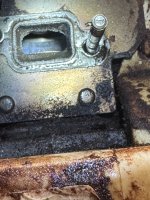
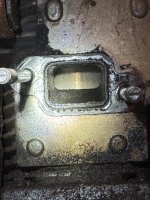
I pulled the muffler and took some pictures. It doesn't look scored to me. My compression tester is 50 plus years old and every I pull the the cord it gets to 90 PSI but by the time I pull it again it leaks down to 40 PSI. I need to order another one. Once I have it I'll post what it is.

Thanks,
Jeff

Cylinder.JPGPiston.JPG
 
Needs to be a small engine specific compression tester with the light Schrader valve in the spark plug fitting to give a true reading.
You are most likely using a generic automotive sized tester that will give false/low readings.
Can see some vertical marks on the piston- might be something, might not.
However, using the oily grime all over the cylinder as an indicator- the saw may well have an air leak and rather than compression testing, I would be pressure and vacuum testing the engine first and foremost.
 
The tester I'm getting says it's for small engines. I've never heard of vacuum testing. How does that work? Is there another device I need to buy?
 
Well yes. if you want to spend money, but there are ways and means to cobble a system together.
Mity vac 8500 is the way to go if doing many. Amazon cheap kit if not doing many, or a bike pump and some bits and bobs of tubing, inner tube and some kind of tube to tube connector.
All that matters is the system delivering the pressure or vacuum is leak proof.

Basically you are sealing off the major inlet and outlets of the engine and then putting the internals under pressure or vacuum to establish if anything is leaking air- like the main crank seals, loose engine pan bolts, impulse hose, intake manifold boot, etc. Pump it up and spray the likely spots with soapy water and check for bubbles forming.
 
I looked at the Mityvac, I've got more than enough parts in my shop to cobble that system together. So, if I understand correctly I need to pull off the carburator and muffler make some plates and bolt them on to seal it. In one of those plates add a fitting to attach a vacuum pump and see if it will hold a vacuum. If it doesn't I'll pressureize it and look for soap bubbles. Did I get that right?
 
Right enough- plenty of " how to " reading and watching out there in Internet land on how to go about it.

With a Stihl you can use the impulse line as the air entry point to save making a plate with air nipple.
Or you can knock the porcelain out of an old spark plug and epoxy a tube into the metal remains to make a threaded air entry point that will work on most any makers engine.
You do not even need plates to blank off- a full rubber sealing gasket from heavy inner tube like tractor/truck tire inner tube between intake and carb- muffler and cylinder will work once the carb and muffler are bolted back down.
 
And the results are in at a wopping 90 PSI. :mad: Wouldn't go any higher.

I'm used to rebuilding car engines so I'm guessing hone the cylinder and install new rings? Or could it be something else with a chainsaw?
 
As a rule- we do not hone cylinders- well at least not in the old school ways.
A ball hone can be of use in the hands of the experienced- but generally- removal of transfer is all you do to coated cylinders- any groove, or gouge you can feel with a pick or fingernail catch is generally a terminal diagnosis,

Of course- knowing there are no major leaks like stripped spark plug threads or faulty decompression valve in the combustion region would be helpful to know. Good air leak at the top of the cylinder will never give a good gauge reading.

Measured skirt wear of the piston will determine a course of action. IF the cylinder can be cleaned up, might be just new rings, if the skirt of the piston is well worn, new piston and rings.

Depending on your mood, experience and budget- for a clamshell style saw, it might be an option to drop in a knock off Asian copycat engine and call it good.
Depends on what you want to have at the end of the day.
 
Well the saw is more sentimental than anything else. I also have a Poulan P4018 and a Husqvarna 455. They have slightly longer bars but basicly the same size. Maybe I should quit while I'm, sort of, ahead as I have many other projects to keep me busy.

I'll hang on to this one and maybe some day when I nothing else to do I'll tear it apart.

Thanks for all your help, it was much appreciated.
Jeff
 
Back
Top