
Stihl 025C

Jeff

New member
Local time
7:05 AM
Joined
Aug 16, 2026
Reaction score
0
Location
VA USA
Hoping someone can help me out. I've got a Stihl 025C. It's about 20 to 25 years old. I can get it to run at high RPM but when I back it down to about half throttle it dies. I can never get it to run slow enough to have the chain stop. Bought it new, never loaned it out and always used 50:1 mix. Any ideas?

Thanks in advance,
Jeff
 
Odds are pretty good, if a saw wont tune or hold tune- it usually has an air leak.
Take the muffler off and look at the piston through the exhaust port- is it scored up?
Pressure and vacuum test would be my first port of call.
 
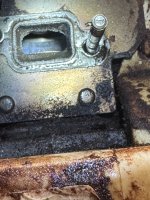
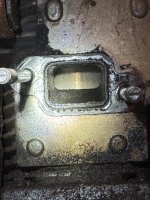
I pulled the muffler and took some pictures. It doesn't look scored to me. My compression tester is 50 plus years old and every I pull the the cord it gets to 90 PSI but by the time I pull it again it leaks down to 40 PSI. I need to order another one. Once I have it I'll post what it is.

Thanks,
Jeff

Cylinder.JPGPiston.JPG
 
Needs to be a small engine specific compression tester with the light Schrader valve in the spark plug fitting to give a true reading.
You are most likely using a generic automotive sized tester that will give false/low readings.
Can see some vertical marks on the piston- might be something, might not.
However, using the oily grime all over the cylinder as an indicator- the saw may well have an air leak and rather than compression testing, I would be pressure and vacuum testing the engine first and foremost.
 
The tester I'm getting says it's for small engines. I've never heard of vacuum testing. How does that work? Is there another device I need to buy?
 
Well yes. if you want to spend money, but there are ways and means to cobble a system together.
Mity vac 8500 is the way to go if doing many. Amazon cheap kit if not doing many, or a bike pump and some bits and bobs of tubing, inner tube and some kind of tube to tube connector.
All that matters is the system delivering the pressure or vacuum is leak proof.

Basically you are sealing off the major inlet and outlets of the engine and then putting the internals under pressure or vacuum to establish if anything is leaking air- like the main crank seals, loose engine pan bolts, impulse hose, intake manifold boot, etc. Pump it up and spray the likely spots with soapy water and check for bubbles forming.
 
Back
Top